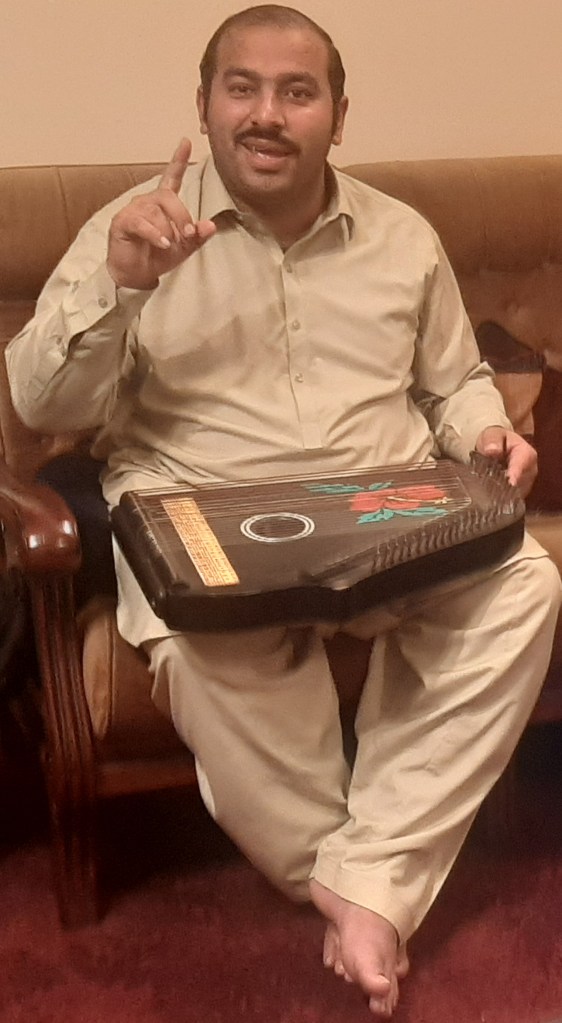
Niaz Khan (b.1993) is an instrument-maker, surmandal-player and singer. His father was an amateur flute-player, but used to work as an electrician professionally. He has two brothers and two sisters, and has two daughters as well. His family had no tradition of playing classical music, and in fact disapproved of his choice of music as a career. As a child he was a talented singer, which led him to appear on local PTV television programs for children. Eventually, he went on to learn singing from the world-famous singer Bade Fateh Ali Khan at the age of eight in Islamabad. Even though he was his main teacher, he also learned from Khan Sahib Sultan Fateh Ali Khan, Khan Sahib Rustam Ali Khan, Ustad Lal Khan, Ustad Arshad Haneen, Ustad Nawab Ali, Ustad Nazir Gul, Mir Tabassum and Khan Sahib Hamid Ali Khan.
He does not restrict himself to any one genre, singing and playing both folk and classical music in over eight languages. Other than the surmandal, he also knows how to make the rubab, chitrali sitar, sarinda, harmonium, tabla, dholak, druza, dhol and flute. His association with the surmandal started when he found a broken surmandal in Bade Fateh Ali Khan’s house. He started to tinker with it, upon which his teacher found him, and began to teach him the basics. Niaz Khan started an academy to teach children singing and playing music, in which some students are taught for free, known as the Khushhal Music School. He teaches many students currently through online apps such as Whatsapp or Messenger, and has visited many countries such as Afghanistan, Kuwait, India, Qatar, Iran, China and Russia to play music since 2006.
Save the Sitar is a website dedicated to promoting and preserving Pakistan’s classical music. Join our growing community to help further our cause!
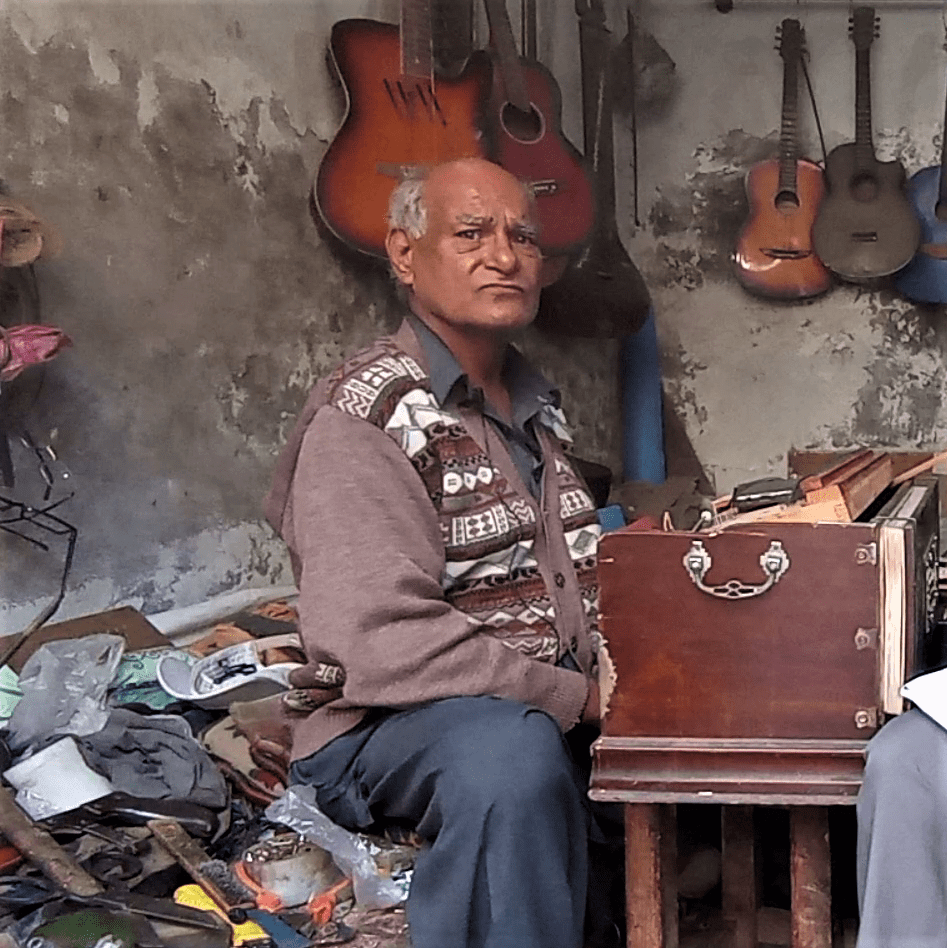
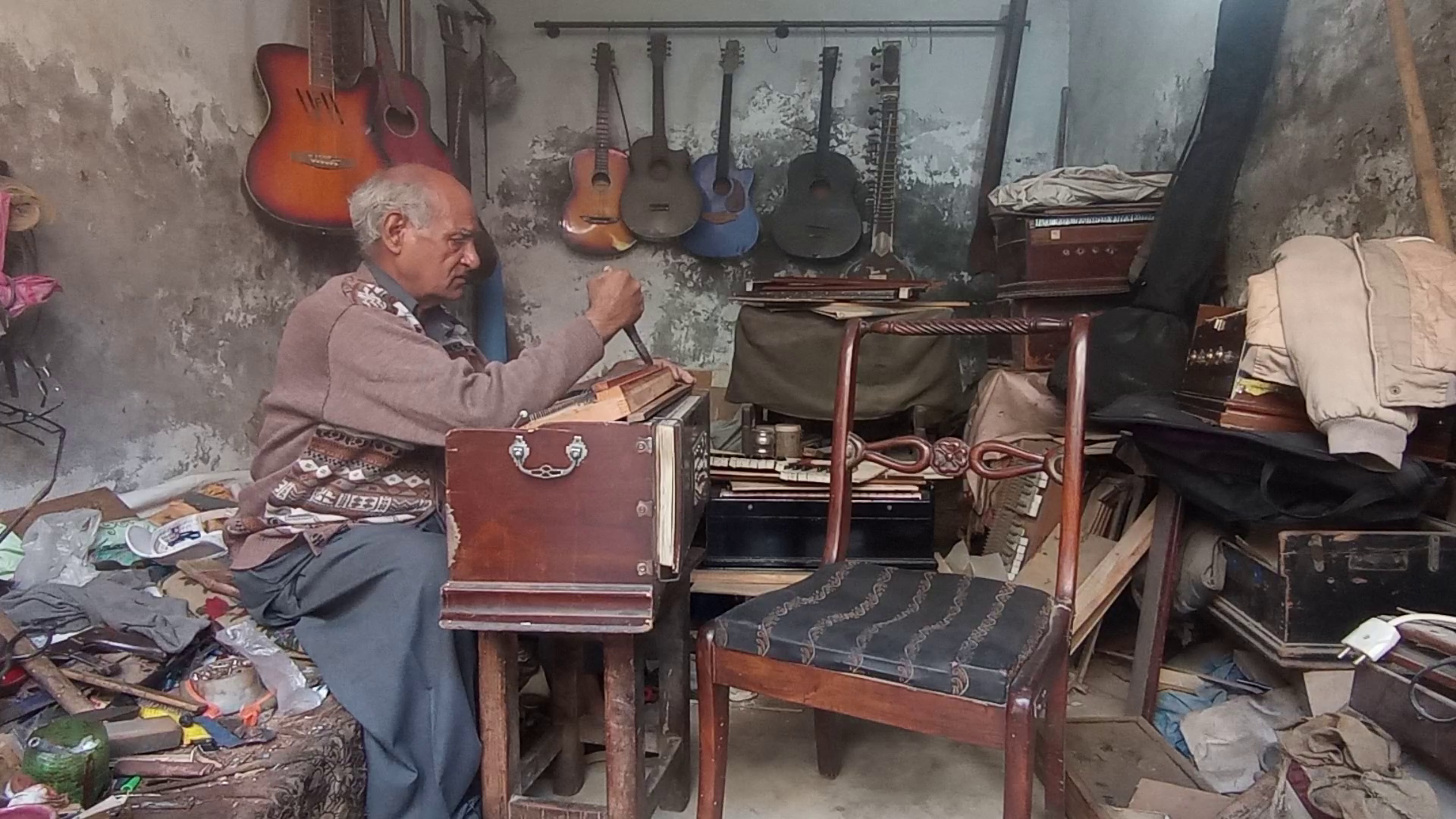
Muhammad Asif (b. 1951) is a Pakistani luthier and proprietor of Bombay Music Store, one of the last sitar shops in Lahore. Opened by his father Muhammad Azim c. 1925, the store supplied Radio Pakistan and various artists with a range of string instruments: from tanpuras to sitars. Muhammad Asif claims that his ancestors made scabbards in the Mughal era, much like Ziauddin, another sitar maker in the vicinity.
One of his brothers, Muhammad Akram (who died in 2017), used to specialize in making harmoniums while, on the other hand, another of his brothers, Muhammad Alam, was a sitar player. Muhammad Asif helped lawyer and intellectual Raza Kazim create the sagar veena, a novel instrument that is similar to the chitra veena. It broke new ground in the music industry through its revolutionary design in 1970, which included its sliding bridge, impressive resonance, and fretless neck.
Muhammad Alam’s children do not help him at his shop in Bansanwala Bazar, but are government employees, an occupation their father approves of due to its financial security.
Save the Sitar has interviewed Muhammad Asif. To learn more about him and his unique store, check out his interview, Bombay in Lahore.
Save the Sitar is a website dedicated to promoting and preserving Pakistan’s classical music. Join our growing community to help further our cause!
A Century Old Sitar Shop: Our Interview with Muhammad Asif
As we entered Bombay Music Store, we could not help notice the inescapable sense of bitterness and decline which was bound to the very soul of the shop and its aging proprietor, Muhammad Asif. Despite our countless interactions with Lahore’s aging classical musicians who are subject to poverty, mistreatment, and social ostracization, there was something that stood out
At the age of 70, Muhammad Asif is still single-handedly running his family’s music store in Bansanwala Bazaar despite recent bouts of age-related diseases. Founded by his father c. 1925, the store used to sell everything from tanpuras to harmoniums, supplying Radio Pakistan and notable artists with the best stringed instruments of Lahore. Sadly, it has fallen on hard times, with a sharp decline in business since 2000. Instead of the sitars and tanpuras which once filled the shop, one can only see cheap Chinese guitars, which sell better, lining the shop nowadays.
When asked about the origin of the store’s name, a rare smile flashes across his face as he recounts how his father, Muhammad Azim, used to spend much of his time in Bombay. When he started a music shop in Lahore, he wanted to pay homage to the city, resulting in the shop’s unique name. Even though his father himself was a luthier, he narrates how his ancestors used to craft sword sheathes in the Mughal era. Interestingly, another sitar maker in the vicinity, Ziauddin, claims that his ancestors had the same occupation at that time.
Muhammad Asif first learned how to make instruments from his father, and later on went on to specialize in sitar-making. One of his brothers, Muhammad Akram (who died in 2017), used to specialize in making harmoniums while, on the other hand, another of his brothers, Muhammad Alam, was a sitar-player. Muhammad Alam used to teach at Alhamra, and also used to perform on Radio Pakistan, being one of Pakistan’s foremost sitarists.
He believes that Alhamra, for which he has repaired and crafted countless instruments, is an organization which is helping preserve classical music in Pakistan, a stance which in sharp contrast to his overall negativity when asked about other NGOs and the government.
When asked about the chances for the revival of classical music, he is not optimistic. He states that even though there may be some young people who are eager to learn it, there are none who can teach them properly anymore, dooming classical music forever. A prime example are his own children: rather than teaching them his family’s age-old musical traditions, he is happy to see them financially secure due to their government jobs.
Out of all the work he has done in his life, he seems to be the proudest of his work on the sagar veena. He helped lawyer and intellectual Raza Kazim create this novel instrument, which is similar to the chitra veena. It broke new ground in the music industry through its revolutionary design in 1970, which included its sliding bridge, impressive resonance and fretless neck. The fact that he is not given credit for his work on the sagar veena on the internet raises many questions in our minds…
The tone of his final message matched that of his whole interview: he solemnly states that all the old classical musicians are dead, and that there is no longer any chance of survival left for classical music. The old way of making instruments is dying out too, and soon, nothing will be left. Upon this solemn note, he waved us goodbye as we wrapped up our microphones and tripod to return to the noisy street outside.
Save the Sitar is a website dedicated to promoting and preserving Pakistan’s classical music. Join our growing community to help further our cause!
An Interview with Veteran Music Director Saleem Haider
Scrolling through a list of popular patriotic songs, it is disappointing to see how few song-writers and composers are credited. Only the singer’s name is seen, everyone else is deemed unimportant. One of these unsung heroes is Saleem Haider, a music director who helped orchestrate the hit songs ‘Ae Watan Pyare Watan’ and ‘Ae Jazba e Dil Gar Main Chahoon’.
Mr. Haider’s family has long been connected to the stage, with their career in drama starting with his great-grandfather, Miyan Sandhi, a friend of the great playwright Agha Hashir Kashmiri. Miyan Sandhi was a great classical singer, but he encouraged his two sons to become actors rather than musicians. Saleem Haider’s mother’s side of the family also has a long tradition of classical music, as seen in his uncle Ustad Nathu Khan, a sarangi maestro. Incidentally, he was also the grandfather of Hassan Ali, another of our interviewees (it’s a small world after all!). Interestingly, Saleem Haider’s father, breaking the mold, was an English professor at M.A.O College. He himself broke the family tradition when he decided to learn music from the music director Akhtar Hussain Akhiyan in 1960, despite his family’s disapproval. Surprisingly, he states that he actually disliked music at first, and was persuaded into learning it at the age of nineteen by his cousin, Mujahid Hussain, a famous music director, who talked him out of continuing his education.
He tells us that he started off his classical music training with the harmonium, and then started to learn the principles of music direction from his ustad much later on. His basic training was mostly provided by his mother’s side of the family, with his uncle, Faiz Khan, playing an important part in his education. He started professionally playing music when he was around twenty-three, in 1964, and also worked at PTV at that time too. He was also an apprentice under Akhtar Hussain Akhiyan at that time as well, continuing his training with him up till 1971.
At the risk of being political, Saleem Haider recounts how the previous government was much more helpful to musicians than the current one is and how he used to receive a stipend of Rs. 20,000 under them. Nowadays, the government pays him small amounts erratically, perhaps Rs. 5,000 after four months.
Talking about his students, he names a few, who were sitting near him during our interview. When pressed as to what he teaches them, he states plainly that it is impossible to directly teach someone an art such as music or poetry. One can only learn them from watching and practicing, day in and day out.
Relating an amusing anecdote about his training, he tells us how his own training under Akhtar Hussain Akhiyan began. Saleem Haider used to get up each morning, catch the five o’clock bus from Bhatti Chowk to get to Kasur, where his ustad lived, bring him to Lahore, and then drop him back each evening. He dutifully followed this routine for three years, a time period in which no formal music instruction took place. It was only then that Akhtar Hussain accepted him as his pupil and said that he had wanted to scare him away with the onerous routine but Haider’s persistence had convinced him otherwise.
At the end of his interview, he advises the younger generation of musicians to try to do things as they were done before, and above all, sing live. He believes that only through performing live on stage can a musician’s worth be actually recognized. After all, with digital technology ‘hum suray ko besura aur besuray ko sureela kar datay hain’ (we turn the in-tune to the out-of-tune and the out-of-tune to the in-tune).
Save the Sitar is a website dedicated to promoting and preserving Pakistan’s classical music. Join our growing community to help further our cause!
We hope that all of you know about the dhol, that lovable cuddly little red wolf-like creature … oops, it seems that we picked the wrong dhol. This is what happens when you have too many homonyms in one place!
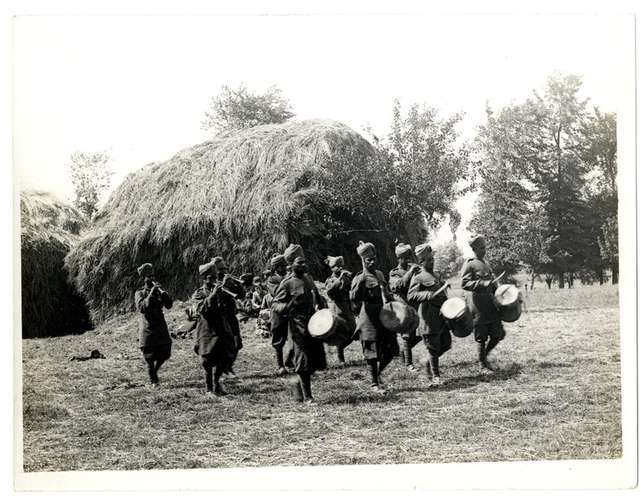
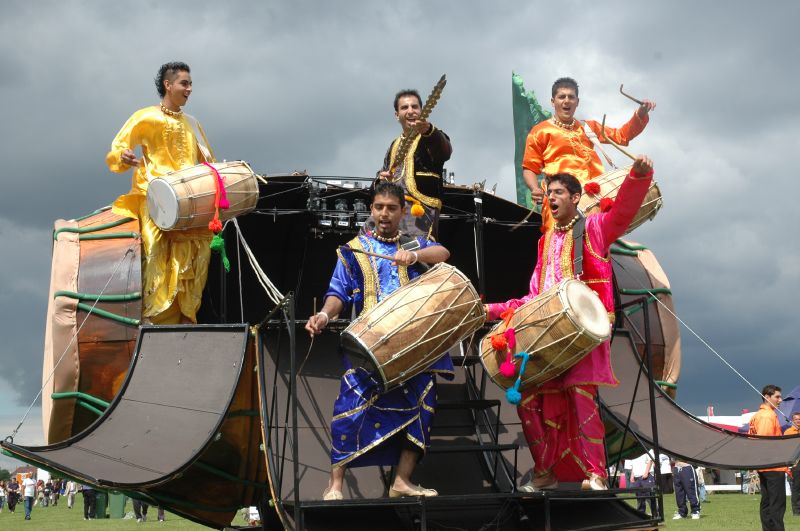
Going on to more serious matters, let’s talk about the real dhol. ‘Door ke dhol suhaney’ (Faraway dhols sound better, the equivalent of ‘The grass is greener on the other side’), a common Urdu proverb, often resonates in our minds while we delve into the history and current situation of the dhol. Even though this lively instrument is present at nearly every other street corner in Lahore, a deeper look reveals how it is a prime example of how traditional folk music has drastically declined. Many traditional rhythms have simply vanished, and many dholchis, or dhol players, are now struggling to provide for themselves on both sides of the border.
However, as we have often said in the past, do not lose hope! The dhol still lives, and is in fact thriving around the world. Various people, both around the world and in Pakistan, are taking interest in this folk instrument, and we sincerely hope that it will continue to prosper.
And finally, to brighten up your day, here’s a video of a dhol performance, recorded by yours truly. Listen to the repetitive yet surprisingly catchy rhythm of the dhol, intelligently distributed between the bass and treble drums: a sure entertainer!
Save the Sitar is a website dedicated to promoting and preserving Pakistan’s classical music. Join our growing community to help further our cause!


 Save the Sitar
.jpg)