He felt like a child in a candy-store. Everything was enticing. His father sat quietly to one side and started talking to the deferential shop keeper; it was not every day that Ustad Ahmadi Khan, the finest sarangi player from the venerable Dehli gharana walked into his shop. The young boy thought for a while, and, going against tradition and all he had been taught, picked out a beautiful carved sitar as his instrument of choice. A normal father might have tried to dissuade his son from his choice, encouraging him instead to pick the tabla or the sarangi, for which the Delhi gharana he belonged to was famed. But Ustad Ahmadi Khan, despite being steeped in centuries of tradition, was deeply modern at heart. He encouraged his son to learn the instrument of his choice, and this young boy grew up to be Ustad Imdad Hussain Khan, who laid the foundation of the Dehli gharana of sitar music.
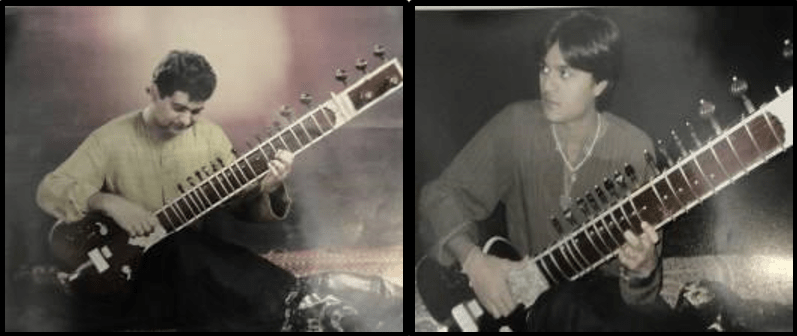
His son, Ikhlaque Hussain Khan, and his grand-son, Turrab Khan, have followed in his footsteps, with Ikhlaque Khan learning not only from his father, but also from the Senia sitar player, Ustad Kabir Khan, and even the legendary Ravi Shankar!
From left to right: Ahmadi Khan and Imdad Hussain KhanFrom left to right: Ikhlaque Hussain Khan and Turrab Khan
Playing Style
These sitar players mainly base their playing style on the semi-classical genre of khayal, but even though the khayal genre is largely vocal, with the singer being the main performer, they instead chose to render khayal solely on the sitar. In fact, unlike the Imdadkhani or Indore gharana, they do not sing at all during their performances, preferring to keep the focus on the sitar itself. Check out a demonstration below!
The Dehli Gharana’s Survival
Turrab Khan was only 25 when his grandfather Ustad Imdad Hussain Khan passed away. However, he had learnt enough from him and his uncle Ustad Ikhlaq Hussain to continue the tradition of the gharana in Pakistan, and is currently musically active.
Save the Sitar is a website dedicated to promoting and preserving Pakistan’s classical music. Join our growing community to help further our cause!
As he was talking to Farhan Khan, a young man in his twenties, Ali Ayub constantly had one eye on the door. He was acutely aware of the prolonged and awkward silences. Finally, an immaculately dressed gentleman, Ustad Rais Khan, walked in with the traditional adab. He seemed to be from a bygone era, where ceremony and rituals were a part of day-to-day life. “He certainly belongs to the court of Indore”, Ali Ayub thought.
The conversation with Ustad Rais Khan was formal, almost verging on cold and awkward. The interview might have ended quickly, but for the fortuitous accident that the dialogue drifted into electric sitars. Ali Ayub was surprised to find that the great maestro was not only open to experimentation, but he himself was participating in quality-testing an electric sitar. “But the neck is getting to be too thick”, opined the master. “Just like a surbahar”, chimed in Ali Ayub. Suddenly Ustad Rais Khan’s eyes lit with approval of this young upstart. “Bilqees, come, meet this young man from NCA. He knows something about music”, he called out to his wife as the guarded formality gave way to a warm and frank interview with one of the greatest sitar players of the subcontinent.
Diametrically opposite to the Jaipur Senia gharana we last visited, the Indore gharana is the most recent and smallest sitar gharana, only founded in the twentieth century. Unlike other gharanas with complex family trees and histories, this one centers around one man who defined the gharana in Pakistan: the famed Ustad Rais Khan (1939-2017).
Ustad Rais Khan discussing music
Rais Khan once controversially claimed himself to be from the Mewati gharana, a statement which’s veracity has been fiercely disputed. Even though he can claim descendance from four different gharanas, he had largely identified with the Indore gharana in the past. However, in the end, most scholars decided to include him in the Indore gharana, as his father and teacher, Muhammad Khan, was from that gharana. Interestingly, his maternal uncle was the celebrated Ustad Vilayat Khan from the Imdadkhani gharana, who greatly influenced his playing style. Later on in his life, Ustad Rais Khan’s relations with his uncle and his uncle’s side of the family appear to have soured, with some saying that Rais Khan had claimed that his father, Muhammad Khan, invented Ustad Vilayat Khan’s famous gayaki ang style, a controversial issue which you can read about here and here.
He received the Presidential Pride of Performance in 2005, and, despite the controversy which naturally resulted due to his rather prickly personality, is widely regarded as among the topnotch sitar players of this era, and a true representative of his gharana. His son, Farhan Khan, has chosen to follow in his footsteps.
From left to right, the late Ustad Rais Khan and his son Farhan Khan
Playing Style
Ustad Rais Khan would brilliantly render khayal vocal bandishes (compositions in a certain raag) on the sitar with great detail and delicacy. Like his maternal uncle Ustad Vilayat Hussain Khan, he also rendered vocal compositions on the sitar, often singing a composition before playing it. As a result, the playing style of this gharana is captured by the Vilayatkhani baj, just like the Imdadkhani baj of the eponymous gharana. However, Ustad Rais Khan controversially contested that his father, and not his uncle, invented this baj.
Even when playing in other bajs, like the Masitkhani baj, players from this gharana tend to be more lyrical as compared to other sitarists, while Ustad Rais Khan also created a distinctive echo effect while playing through the controlled decrease in the intensity of the mizrab strokes.
The Young Man Carrying on the Indore Tradition
The young man that Ali Ayub met was Farhan Khan the son of Ustad Rais Khan. His father’s meticulous training and his own hard work have transformed Farhan Khan into one of the most promising sitar players from Pakistan. He lives in Karachi and performs in concerts all over the world.
Just as a little bonus, below is a short example of Ustad Rais Khan’s playing style. Enjoy!
Save the Sitar is a website dedicated to promoting and preserving Pakistan’s classical music. Join our growing community to help further our cause!
As soon as the performance ends, the whole hall erupts into applause. The great yet deaf master has his eyes closed as if in a trance. He finally opens his eyes to feast on the energy of his rapturous audience. This great master is not Beethoven, but Ustad Fateh Ali Khan, the finest exponent of the Kapurthala tradition of sitar playing.
The Kapurthala gharana traces its history back to the 18th century, to a veena player named Mir Nasir Ahmed, who migrated from Delhi to Kapurthala in 1858. His two sons, Mir Kallan and Mir Rehmat Ali, went on to become distinguished veena and sursingar players, with Mir Rehmat Ali even learning the sursingar from a (supposedly) direct descendant of Tansen. According to legend, Mir Rehmat Ali became such an accomplished and well-esteemed musician that the Mughal Emperor himself gave a surbahar to him as a sign of respect! This surbahar is said to have then been handed on to Bhai Mehboob Ali, Mir Rehmat Ali’s disciple, and one of the rababi sitar players of Kapurthala.
The Kapurthala rababis, have always been closely affiliated with the rulers of this small Punjabi princely state. The rababis are a group of musicians primarily known for their association with Sikh religious music, with the group being named for its historical association with the rabab, a common folk instrument. Most of its members settled in Lahore after Partition, where they started working in the film and radio industries.
Bhai Mehboob Ali (1880-1946)
In Pakistan, Ustad Fateh Ali Khan, Bhai Mehboob Ali’s nephew, used to be the main exponent of this tradition until his death in 1981, upon which he was succeeded by his son, Ustad Nafees Ahmed Khan. He was the disciple of his uncle, Bhai Mehboob Ali, but later on moved to Lahore instead of stay in Patiala, where he was born. Here he started to work as a composer and instrumentalist for the film industry, and composed music for many films.
He was greatly praised for his skill, but chose to move on from the film industry in 1960, when he moved to Rawalpindi, and started to work as a staff artist at Radio Pakistan Islamabad. During his career, he toured India and Turkey, and in 1978, he was awarded the Pride of Performance.
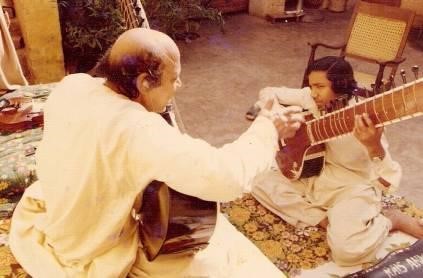
Ustad Fateh Ali Khan giving lesson to his son Nafees Ahmed Khan
The Playing Style
The Kapurthala Rababi tradition heavily relies on the bold, rather aggressive Purab baj, which is greatly inspired by the pakhawaj. They also use two mizrabs while playing, unlike the other sitar players, and Ustad Nafees Khan himself tends to elaborate more on the basic gat as compared to his father, Ustad Fateh Ali Khan. We can thus see influences from both the rababis and Mir Nasir Ahmed’s sons in their playing style, which you can listen to below.
The Kapurthala gharana in the twenty-first century
Exponents of the Kapurthala gharana in Pakistan, because of its close links with Sikhism, has been a bit reluctant to own up to its multi-religious tradition. However, the Kapurthala gharana lives on with the greatly esteemed Ustad Nafees Khan. He is a faculty member at the National Academy of Performing Arts (NAPA) in Karachi. Ustad Nafees Khan not only steadfastly protects the centuries old Kapurthala knowledge base but has also incorporated his own unique innovations into this great tradition.
Save the Sitar is a website dedicated to promoting and preserving Pakistan’s classical music. Join our growing community to help further our cause!
So far we have mostly talked about glamourous and well-known—well, at least comparatively well-known—musical instruments. The tabla, the sitar, the sarangi – all of these take centre stage in any classical music performance. Yet for every much-acclaimed star performer there are dozens of unthought of and ignored people working patiently backstage. The world of classical music is no exception – as the tanpura proves.
The tanpura is a sitar-like instrument which is used to support other instrument’s or singer’s melodies rather than to make its own by maintaining a constant drone. This drone is always a specific key, and is produced by plucking a cycle of four strings in an unchanging and precisely timed loop, as seen below. This background drone is an inconspicuous yet vital part of a classical music performance, supporting the other performers and serving as a reference point for melodic improvisation and intricate rhythms.
Nowadays, however, the tanpura is being increasingly replaced by the electronic tanpura and audio recordings, which are both easier to use and less expensive than hiring an actual tanpura player. This instrument is the most vulnerable of all to modernization, as it can be easily replicated by a drone-producing machine. However, many musicians find these substitutes to be lacking in nuance and monotonous, and claim that they can never replace the expertise of professional tanpura players. All this controversy goes to show the importance and value of the tanpura, the instrument behind the instruments.
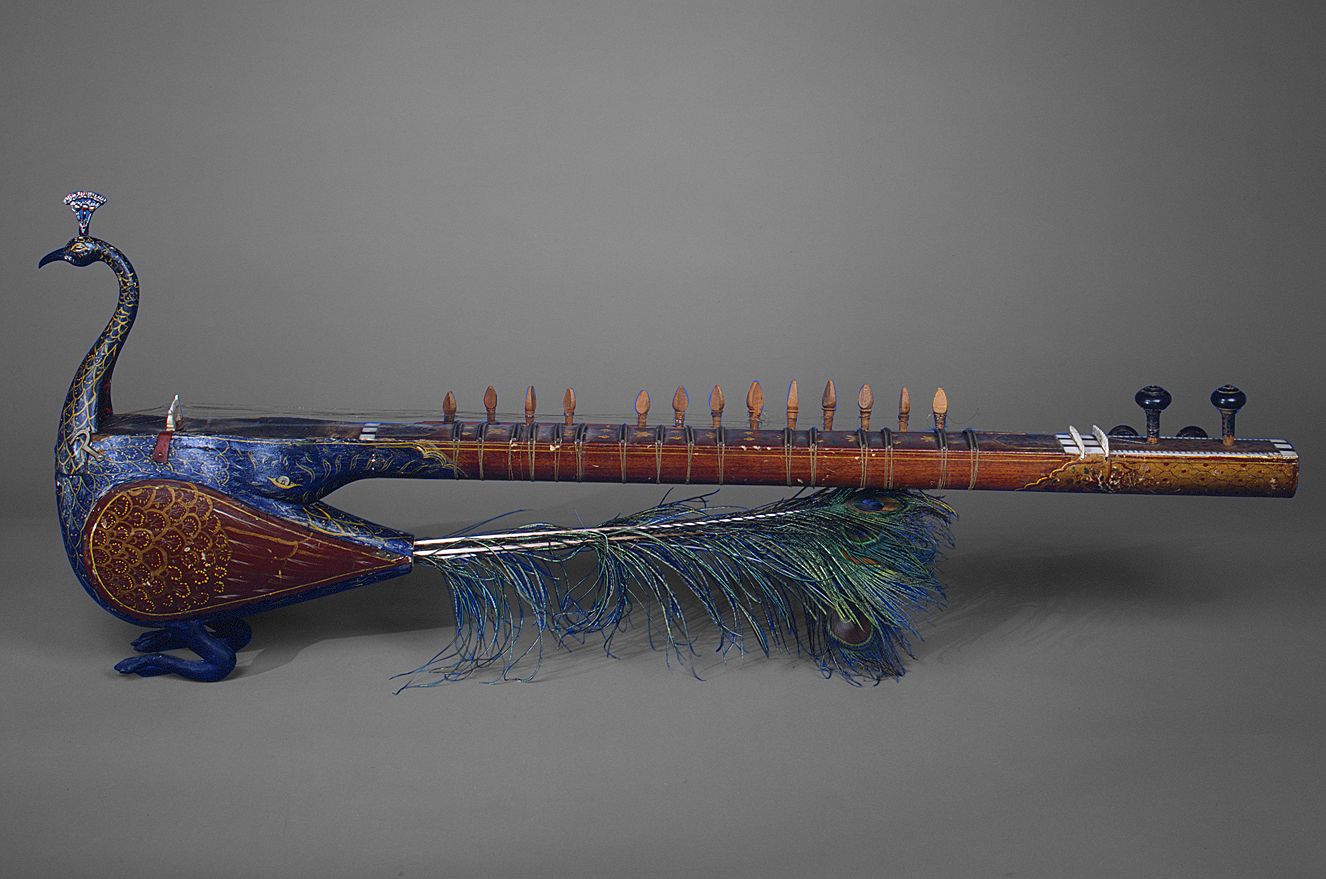
Most instruments, though definitely not ugly (just look at the sitar) are more made for function, rather than form. The taus (Persian for peacock) however, seems to have been made with the opposite purpose in mind. Just look at it!
The taus is said to have been invented when the Sikh Guru, Guru Gobind Singh, and some of his companions, were resting under a tree after singing and playing stringed instruments, with their instruments lying on the ground. All of a sudden, a peacock came up to them, and let out a cry, which made all of the instruments’ strings resonate. The Guru liked the sound so much that he resolved to make an instrument which captured it beautifully, thus leading to the invention of the taus.
However, one should not be unfair to the taus; its voice is just as beautiful as its outward appearance, and is definitely not an instrument which prizes looks more than performance. If you don’t believe us, look at the video below!
Save the Sitar is a website dedicated to promoting and preserving Pakistan’s classical music. Join our growing community to help further our cause!






 Save the Sitar