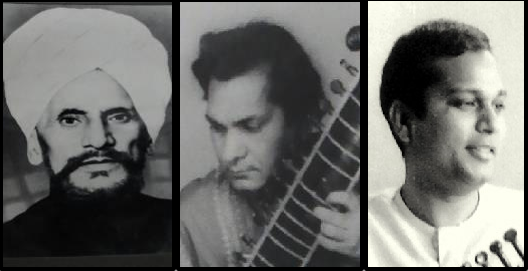
The atmosphere at Bagh-e-Jinnah was electric. It almost felt as though all of Lahore was out to feast on music. It was a celebration of a centuries old tradition that was dying but certainly not dead yet. Hundreds of people were attending the December 2007 All-Pakistan Music Conference. Ali Ayub, carrying a camera and laptop, followed Dr. Lowell Lybarger into the green room. He had forgotten all about the stinging cold air and the maddening traffic that he had encountered on his motorcycle ride to the venue. His attention was riveted by a young man at the centre of a crowd in the corner who was surrounded by fans, students, and musicians. The star was none other than Ashraf Sharif Khan, the son of Ustad Sharif Khan.
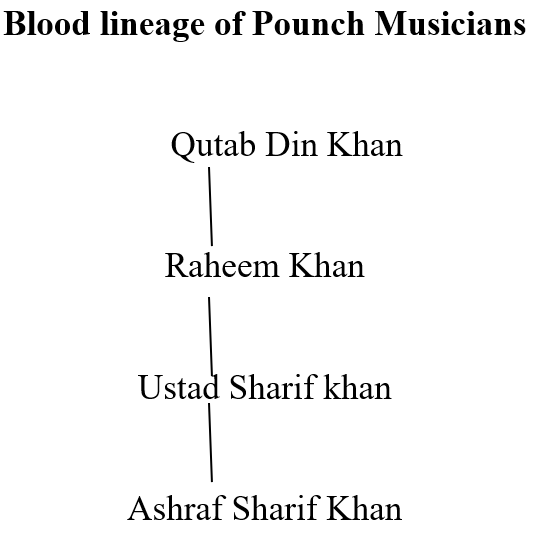
Much like the Indore Gharana that centered around Ustad Rais Khan, the Pounch gharana centers around one of the most famous and successful Pakistani sitar players, Ustad Sharif Khan. While this gharana may be relatively unknown, it flourished in the court of Maharaja of Pounch, who was a connoisseur of music and played the surbahar himself.
Ustad Sharif Khan’s skills and style were defined by the fact that he was not only trained in the surbahar and the sitar by his own father and uncle, but was later the disciple of the amazing sitar player, Ustad Imdad Khan (the very first sitarist to ever be recorded and founder of the Imdadkhani sitar gharana).
After getting his initial training from his father, Ustad Sharif Khan, following in his father’s footsteps, became a disciple of Imdad Khan’s son. Later, after Partition, Ustad Sharif Khan’s family migrated to Lahore, where his son would be born. Ustad Sharif Khan, or rather Ustad Sharif Khan Pounchwaley as he went on to be known as, developed his own distinct style, which came to be known as the Sharifkhani baj, and won many prestigious awards, like the Pride of Performance.

The Playing Style
Ustad Sharif Khan developed his own baj, the Sharifkhani baj, which is quite exceptional. The baj is a blend of the Imdadkhani baj and the style of the dhrupad genre, as he was born to a family of dhrupad musicians. He was also known for using a unique mixture of the veena and the surbahar’s meend (sliding between notes),showing how his playing style was an amalgamation of all of the various techniques of the surbahar, the veena and the sitar. It is also interesting to note that even though he was taught by a member of the Imdadkhani gharana, his baj is different from that of other exponents of this gharana, as his style is more like that of his teacher’s father, Ustad Imdad Khan, than that of the newer exponents of the gharana, like Ustad Vilayat Khan. As a result, his performances are much less influenced by the khyal vocal genre, and are far more austere as compared to those of the newer Imdadkhani exponents.
The Poonch Gharana in the Twenty First Century
Initially Ashraf Sharif Khan found it hard to establish his own separate identity. However, his hard work and training have led him to make his mark. He has amalgamated Ustad Vilayat Khan’s lyricism with khayal ang to carve out his own legacy. He is currently carrying on his father’s legacy by teaching the sitar at Oslo.
Save the Sitar is a website dedicated to promoting and preserving Pakistan’s classical music. Join our growing community to help further our cause!
Follow Save the Sitar!
Get new content delivered directly to your inbox.
 Save the Sitar